Email : sales@parraid.com
Call Us : +1 (301) 690-0690

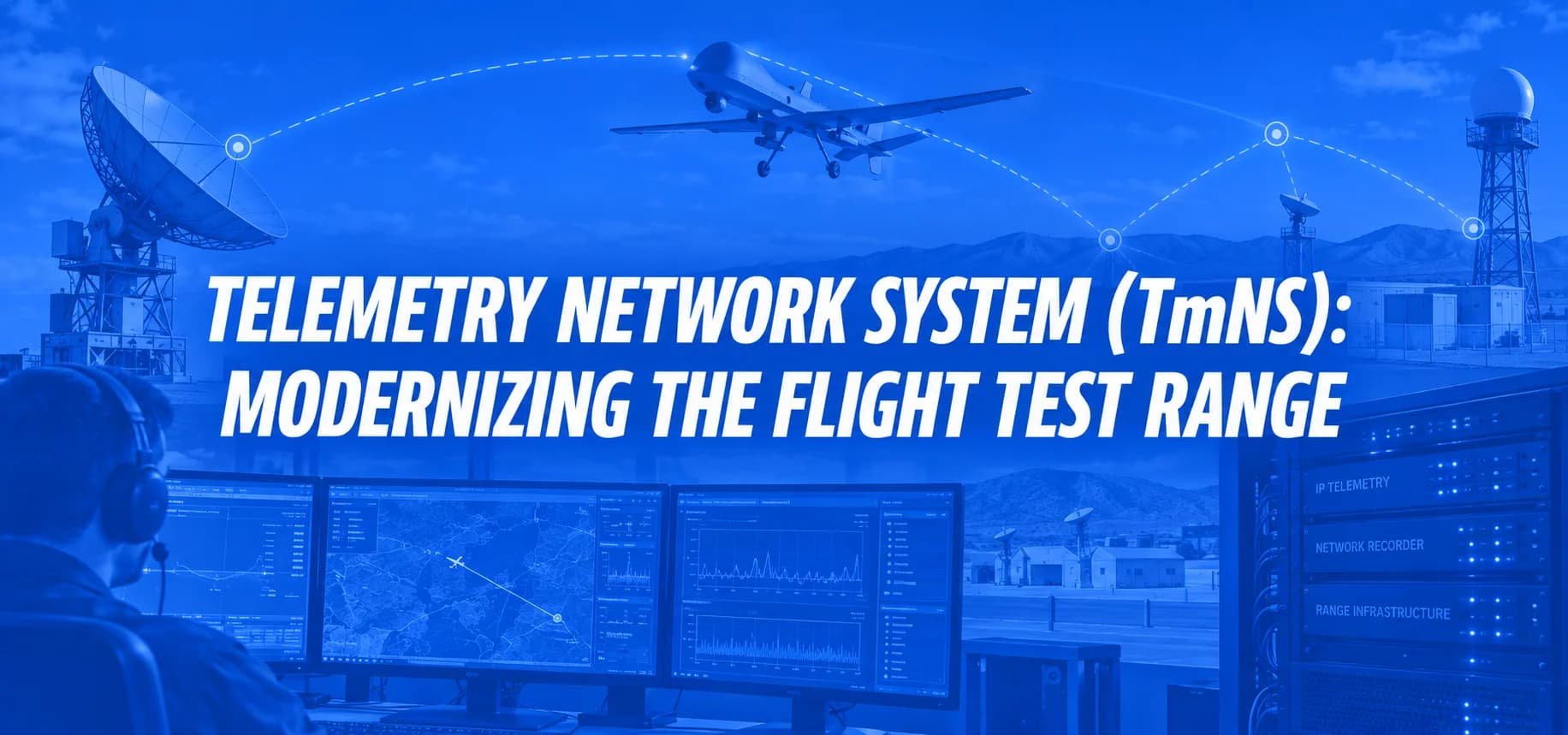
The flight test range has been slow to change. For decades, the fundamental architecture of the range included antenna systems feeding receivers, receivers feeding recorders, recorders feeding analysis workstations and has remained essentially unchanged even as the aircraft and weapons systems being tested became dramatically more complex. The Telemetry Network System, or TmNS, represents a decisive break from this architecture, replacing the point-to-point analog infrastructure of the traditional range with a flexible, IP-based network that can accommodate the data rates, the distribution requirements, and the geographic complexity of modern flight test programs.
TmNS is the next-generation architecture for flight test range instrumentation networks, specified in the emerging IRIG 106 standards and being adopted by major test ranges and prime contractors. The defining characteristic of TmNS is the replacement of the traditional analog signal chain with an IP network as the primary data transport medium. In a TmNS architecture, telemetry data is converted to IP as close to the antenna as possible and carried over a standard Ethernet network to any system that needs it, recorders, processors, displays, or remote facilities.
A TmNS architecture consists of several types of network nodes: Network Addressable Telemetry Units (NATUs) that convert incoming RF telemetry to IP streams, Network Addressable Recorders (NARs) that record IP telemetry streams to storage, and Network Addressable Processing Units (NAPUs) that perform real-time decommutation and processing of IP telemetry streams. The IMUX RE-CON functions as a Network Addressable Recorder within a TmNS architecture.
The TmNS architecture delivers several concrete benefits over the traditional analog range architecture. Distribution flexibility is dramatically improved and any TmNS node can receive data from any other node over the network, enabling configurations that would be impossible with direct analog connections. Adding new consumers of telemetry data requires only a network connection, not dedicated analog cabling. And the network's inherent redundancy provides resilience against single point failures that would be catastrophic in an analog chain.
Transitioning existing range infrastructure to TmNS is not a simple task. Legacy equipment including older receivers, recorders, and processing systems may not support IP interfaces, requiring replacement or the addition of gateway devices. Personnel must be trained on IP networking concepts in addition to traditional telemetry signal processing. And the TmNS standards themselves are still evolving, creating uncertainty about which features to prioritize in early deployments. Parraid's portfolio provides a migration path that allows ranges to adopt TmNS capabilities incrementally.
Full TmNS implementation is a multi-year journey for most test ranges, but the benefits justify the investment. Ranges that complete the transition will have a flexible, scalable infrastructure that can accommodate the demands of future test programs without costly infrastructure replacements. Parraid's telemetry solutions — including the IMUX RE-CON, G2e, and OMEGA NExT — are all designed to support TmNS operations. Contact Parraid to plan your TmNS transition.
Powering secure, real-time data transmission across land, sea, and sky.
Dive into our blog for the latest trends, tips, and insights in the world of design and AI technology. Whether you’re looking for inspiration, tutorials, or industry news, our articles are crafted to keep you informed and inspired.


Parraid provides tactical communications solutions, telemetry data systems, and deployable communication products that support mission-critical operations around the globe. Below are some of the most common questions about our technology, services, and support.
Parraid works with aerospace, defense, government, and research organizations that depend on real-time data and secure communications. Our products are engineered to meet the unique operational needs of mission-critical and tactical environments.
Our telemetry data systems enable accurate data acquisition, recording, and playback across test ranges and aerospace applications. With IRIG-106 compliance and TMoIP support, we deliver precise insights for faster mission validation and system performance analysis.
Parraid’s tactical communications solutions are designed for interoperability and resilience. They integrate seamlessly with multi-band radios, SATCOM, and IP-based networks to maintain command, control, and situational awareness in any field condition.
Yes. Our deployable communication products are lightweight, ruggedized, and MIL-STD compliant, ideal for rapid setup and sustained connectivity in mobile or remote missions.
Absolutely. We work closely with our customers to design and configure systems tailored to their operational goals. Whether upgrading existing telemetry infrastructure or developing a fully deployable communication suite, we ensure seamless integration and lifecycle support.
All Parraid systems are designed, built, and supported in the United States. Our team of engineers and specialists provides continuous technical support to ensure mission reliability and customer success.
Connect With Our Team
All Parraid systems are designed, built, and supported in the United States. Our team of engineers and specialists provides continuous technical support to ensure mission reliability and customer success.
Powering secure, real-time data transmission across land, sea, and sky.

Parraid delivers mission-critical telemetry and tactical communications solutions designed to perform when failure is not an option.