Email : sales@parraid.com
Call Us : +1 (301) 690-0690

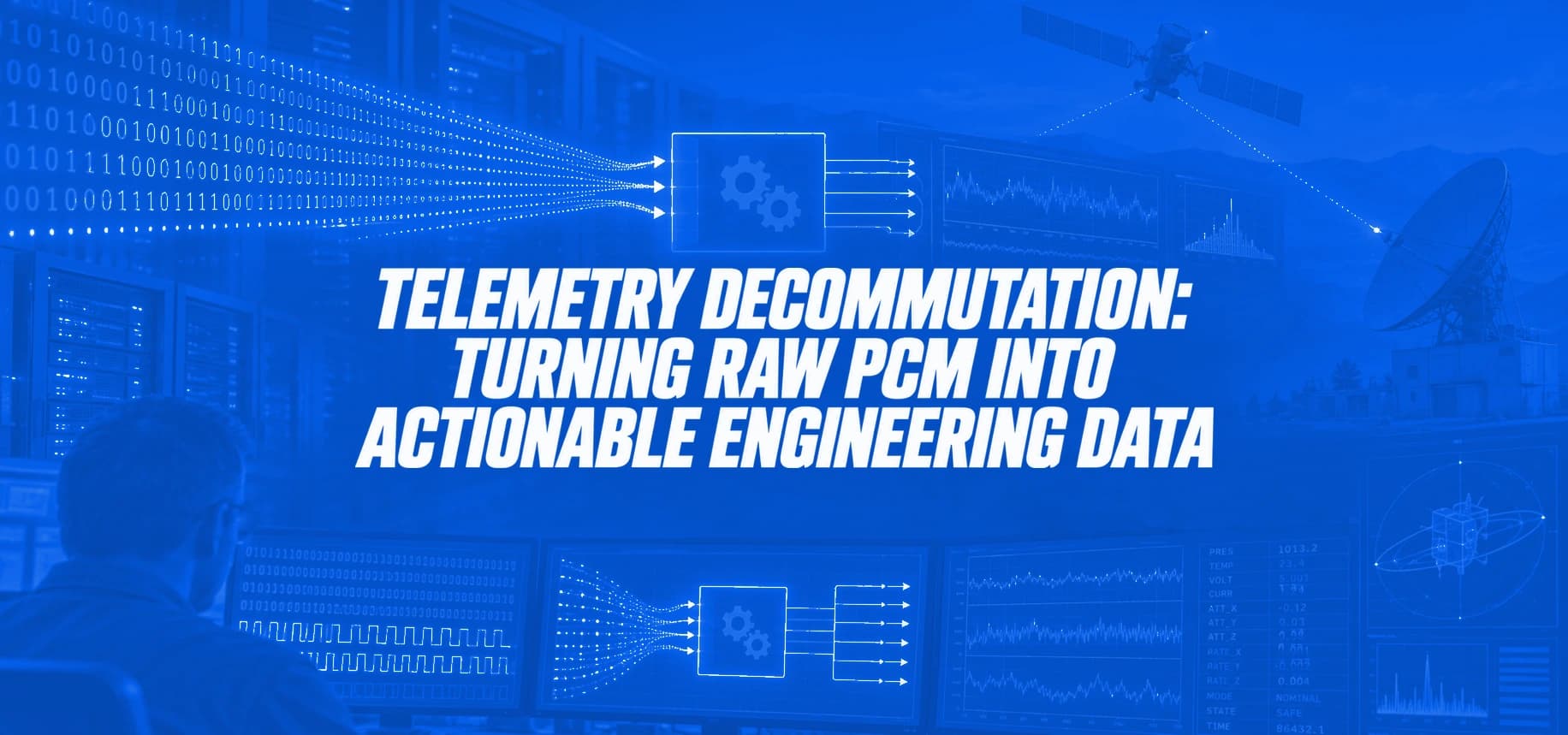
To a computer, a raw PCM telemetry stream is nothing but a long sequence of ones and zeros. To an engineer, it represents thousands of individual measurements of temperature, pressure, acceleration, voltage, and dozens of other parameters, if and only if they know exactly how those measurements were encoded into the bit stream. Telemetry decommutation is the process of decoding this bit stream according to the frame structure defined for the specific test article, extracting individual parameter values and converting them into engineering units. Without decommutation, raw PCM is meaningless; with it, the complete engineering story of the flight becomes accessible.
A PCM telemetry stream is organized as a series of frames, each with a fixed structure that places specific parameter values at known bit positions within the frame. The decom reads the frame sync word and a known bit pattern that identifies the start of each frame and then extracts parameter values from their defined bit positions within the frame. For parameters that change faster than the frame rate allows, subframes provide higher-rate sampling of selected parameters within the overarching frame structure.
The decom must also apply calibration: the raw digital value extracted from the bit stream represents a voltage or count that must be converted to engineering units such as, feet, degrees Celsius, pounds per square inch, etc. Using the calibration curve or conversion equation defined for that sensor.
Telemetry decommutation can be implemented in dedicated hardware or in software running on general-purpose processors. Hardware implementations offer the best real-time performance and are resistant to processing load variations that can cause software systems to lose data. Software implementations offer greater flexibility for parameter database changes and are easier to update as the test article instrumentation evolves. The S-5000e data processor uses a hardware-accelerated architecture that combines the performance of hardware decommutation with the configurability of software such as OMEGA NExT.
Decommutation can be performed in real time during the flight, providing immediate engineering unit displays to test conductors or in post-processing after the flight. Real-time decommutation using OMEGA NExT provides immediate situational awareness during live test events. Post-processing decommutation using the Omega Data Environment (ODE) enables more thorough analysis of recorded data after the flight, with more processing time available for complex conversions and statistical analysis.
The quality of decommutation is directly dependent on the accuracy and completeness of the telemetry database that describes the frame structure, parameter locations, and calibration curves for the test article. OMEGA NExT includes comprehensive database management tools that allow engineers to define and maintain this database, with version control that tracks changes throughout the test program and ensures that the correct database version is applied when processing recordings from specific test dates.
Modern test programs often involve simultaneous decommutation of multiple independent telemetry streams, the primary test vehicle, a chase aircraft, and a range safety transmitter. OMEGA NExT handles this multi-source complexity by supporting independent decommutation configurations for each stream, allowing the test team to monitor the complete operational picture from a single workstation. Explore OMEGA NExT and the S-5000e for complete decommutation solutions.
Powering secure, real-time data transmission across land, sea, and sky.
Dive into our blog for the latest trends, tips, and insights in the world of design and AI technology. Whether you’re looking for inspiration, tutorials, or industry news, our articles are crafted to keep you informed and inspired.

Parraid provides tactical communications solutions, telemetry data systems, and deployable communication products that support mission-critical operations around the globe. Below are some of the most common questions about our technology, services, and support.
Parraid works with aerospace, defense, government, and research organizations that depend on real-time data and secure communications. Our products are engineered to meet the unique operational needs of mission-critical and tactical environments.
Our telemetry data systems enable accurate data acquisition, recording, and playback across test ranges and aerospace applications. With IRIG-106 compliance and TMoIP support, we deliver precise insights for faster mission validation and system performance analysis.
Parraid’s tactical communications solutions are designed for interoperability and resilience. They integrate seamlessly with multi-band radios, SATCOM, and IP-based networks to maintain command, control, and situational awareness in any field condition.
Yes. Our deployable communication products are lightweight, ruggedized, and MIL-STD compliant, ideal for rapid setup and sustained connectivity in mobile or remote missions.
Absolutely. We work closely with our customers to design and configure systems tailored to their operational goals. Whether upgrading existing telemetry infrastructure or developing a fully deployable communication suite, we ensure seamless integration and lifecycle support.
All Parraid systems are designed, built, and supported in the United States. Our team of engineers and specialists provides continuous technical support to ensure mission reliability and customer success.
Connect With Our Team
All Parraid systems are designed, built, and supported in the United States. Our team of engineers and specialists provides continuous technical support to ensure mission reliability and customer success.
Powering secure, real-time data transmission across land, sea, and sky.
Parraid delivers mission-critical telemetry and tactical communications solutions designed to perform when failure is not an option.