Email : sales@parraid.com
Call Us : +1 (301) 690-0690

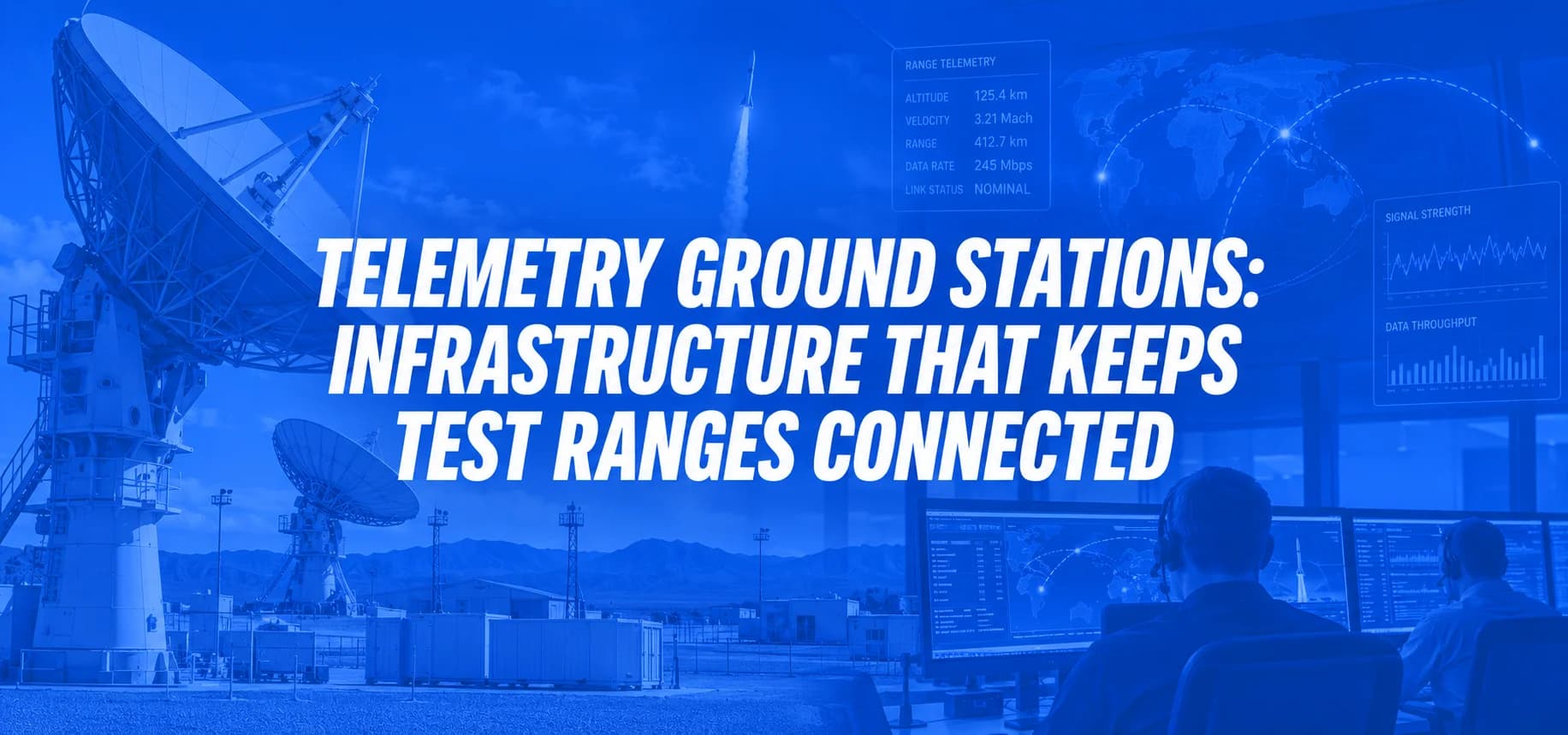
The aircraft flies the test card, the missiles ignite and fly their trajectories, the spacecraft reaches orbit, but none of the data generated by these events serves any purpose unless it is captured at the ground station. The telemetry ground station is the infrastructure that receives the RF signals broadcast by test articles, converts them to digital data, records them for post-flight analysis, and distributes them to the real-time monitoring systems that keep test conductors and range safety officers informed during the test event. The quality and capability of the ground station directly determines what data is available for engineering analysis.
A complete telemetry ground station includes antenna systems for RF signal acquisition, receivers for demodulation and signal conditioning, recorders for long-term data storage, processing systems for real-time engineering unit conversion, and display systems for real-time monitoring. Parraid provides solutions for every element of this chain: the Rx2 receiver for RF reception and diversity combining, the IMUX G2e recorder for Chapter 10 recording, the S-5000e processor running OMEGA NExT for real-time decommutation, and using OMEGA NExT's "Clarity" for real-time display.
Test ranges include both fixed ground stations with permanent antenna installations and mobile stations that can be repositioned to provide coverage for test operations outside the fixed station network. The EDGE² telemetry network appliance is designed specifically for mobile ground station applications, providing a compact capability that can be deployed wherever the test mission requires. When paired with a portable antenna system, laptop and OMEGA NExT software, the EDGE² creates a fully functional mobile ground station that can be operational within minutes.
Modern telemetry ground stations are IP-based networks rather than collections of point-to-point analog connections. This network architecture enables flexible data distribution, any processing or recording system connected to the network can receive any telemetry stream and supports remote access to ground station data from off-site facilities. The G3 TMoIP platform provides the distribution hub function in this architecture, receiving incoming telemetry streams and distributing them to all connected systems simultaneously.
For programs where data loss has significant consequences, expensive re-flights, program delays, or safety implications where ground station redundancy is essential. Redundant receive antennas, redundant receivers, and redundant recording paths all contribute to a ground station architecture that can tolerate individual component failures without data loss. The IMUX RE-CON network recorder adds a further layer of resilience by automatically recording all telemetry streams that appear on the network, providing backup recording capability for streams that may also be recorded by dedicated recorders.
Designing a telemetry ground station that meets the requirements of a specific test program requires careful analysis of the test article's telemetry characteristics, the range geometry, the data distribution requirements, and the post-flight processing needs. Parraid's team of telemetry engineers has extensive experience in ground station design and can provide expert guidance throughout the design process. Visit Parraid's telemetry systems page to explore ground station solutions.
Powering secure, real-time data transmission across land, sea, and sky.
Dive into our blog for the latest trends, tips, and insights in the world of design and AI technology. Whether you’re looking for inspiration, tutorials, or industry news, our articles are crafted to keep you informed and inspired.
Parraid provides tactical communications solutions, telemetry data systems, and deployable communication products that support mission-critical operations around the globe. Below are some of the most common questions about our technology, services, and support.
Parraid works with aerospace, defense, government, and research organizations that depend on real-time data and secure communications. Our products are engineered to meet the unique operational needs of mission-critical and tactical environments.
Our telemetry data systems enable accurate data acquisition, recording, and playback across test ranges and aerospace applications. With IRIG-106 compliance and TMoIP support, we deliver precise insights for faster mission validation and system performance analysis.
Parraid’s tactical communications solutions are designed for interoperability and resilience. They integrate seamlessly with multi-band radios, SATCOM, and IP-based networks to maintain command, control, and situational awareness in any field condition.
Yes. Our deployable communication products are lightweight, ruggedized, and MIL-STD compliant, ideal for rapid setup and sustained connectivity in mobile or remote missions.
Absolutely. We work closely with our customers to design and configure systems tailored to their operational goals. Whether upgrading existing telemetry infrastructure or developing a fully deployable communication suite, we ensure seamless integration and lifecycle support.
All Parraid systems are designed, built, and supported in the United States. Our team of engineers and specialists provides continuous technical support to ensure mission reliability and customer success.
Connect With Our Team
All Parraid systems are designed, built, and supported in the United States. Our team of engineers and specialists provides continuous technical support to ensure mission reliability and customer success.
Powering secure, real-time data transmission across land, sea, and sky.
Parraid delivers mission-critical telemetry and tactical communications solutions designed to perform when failure is not an option.