Email : sales@parraid.com
Call Us : +1 (301) 690-0690

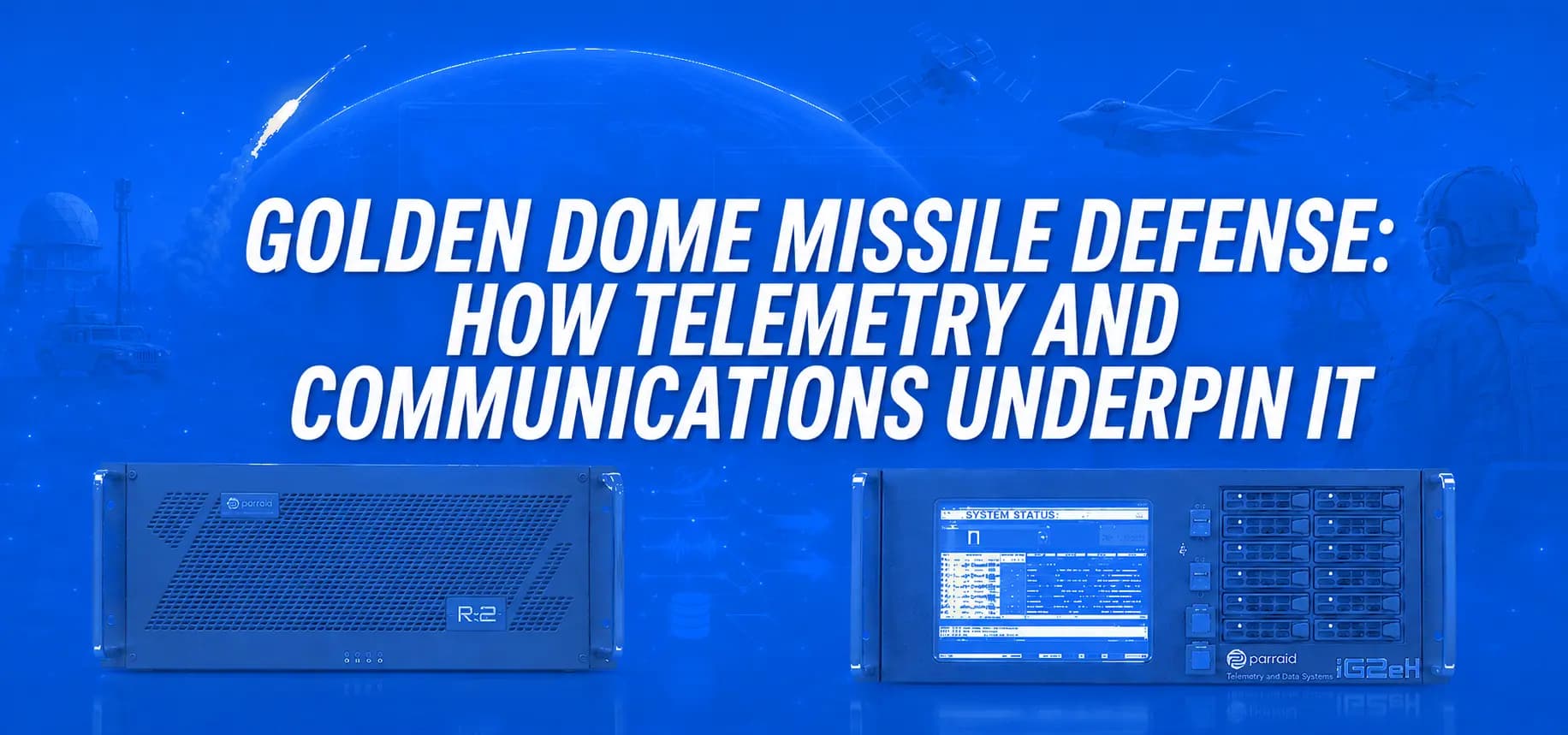
The United States has long sought to establish a credible, multi-layered missile defense architecture capable of intercepting ballistic, cruise, and hypersonic threats. The latest manifestation of this ambition of the Golden Dome concept, which envisions an integrated defense network spanning ground, sea, air, and space layers, combining sensors, interceptors, and command and control systems in a unified architecture. While much of the public discussion focuses on the interceptors themselves, the telemetry and communications infrastructure that enables Golden Dome to function is equally critical and equally demanding.
An integrated missile defense system like Golden Dome depends on the rapid, reliable exchange of sensor data and command and control information among geographically dispersed assets. Radar systems must share track data with interceptor batteries. Space-based sensors must relay early warning data to ground-based command centers. Interceptors in flight must relay telemetry data to range-safety officers and post-mission analysts. All of this data must flow with the speed and reliability required for split second decisions to defend the USA, across communications links that adversaries will actively attempt to disrupt.
Before any missile defense system can be fielded, it must be extensively tested. Interceptor testing generates some of the most demanding telemetry requirements in the aerospace industry: very high data rates from dense sensor suites, brief mission durations that leave no margin for recording gaps, and extraordinary performance requirements for the receiving and recording infrastructure. Parraid's IMUX G2e and G2eH recorders provide the dual-path Chapter 10 recording capability needed to capture every bit of data from these critical test events.
Interceptor testing often involves high-velocity test articles that transit large areas of the test range at altitudes and speeds that challenge conventional tracking systems. The Rx2 multi-channel receiver provides tri-band coverage and built-in diversity combining that maintains robust telemetry reception even as the test article transitions between antenna coverage sectors at high speed. Its direct IP output integrates naturally with modern range infrastructure, minimizing the time from receipt of telemetry data to its availability for real-time safety monitoring.
Operational missile defense systems require communications infrastructure that is highly reliable, resistant to electronic warfare, and capable of operating across the full range of environments where U.S. forces may be deployed. The NRG and deployable communications solutions from Parraid support these requirements by providing robust, IP-based radio gateway capability that can connect missile defense command and control nodes across diverse tactical environments.
The telemetry data from missile defense tests serves not just engineering purposes but also legal and contractual purposes, documenting that tests were conducted as planned and that interceptors performed as specified. The data integrity features built into Parraid's recording systems, including time-correlated recording, redundant capture paths, and comprehensive recording logs, provide the chain-of-custody documentation needed to support these requirements. To learn how Parraid supports missile defense testing programs, visit the telemetry systems page or contact the team.
Powering secure, real-time data transmission across land, sea, and sky.
Dive into our blog for the latest trends, tips, and insights in the world of design and AI technology. Whether you’re looking for inspiration, tutorials, or industry news, our articles are crafted to keep you informed and inspired.

Parraid provides tactical communications solutions, telemetry data systems, and deployable communication products that support mission-critical operations around the globe. Below are some of the most common questions about our technology, services, and support.
Parraid works with aerospace, defense, government, and research organizations that depend on real-time data and secure communications. Our products are engineered to meet the unique operational needs of mission-critical and tactical environments.
Our telemetry data systems enable accurate data acquisition, recording, and playback across test ranges and aerospace applications. With IRIG-106 compliance and TMoIP support, we deliver precise insights for faster mission validation and system performance analysis.
Parraid’s tactical communications solutions are designed for interoperability and resilience. They integrate seamlessly with multi-band radios, SATCOM, and IP-based networks to maintain command, control, and situational awareness in any field condition.
Yes. Our deployable communication products are lightweight, ruggedized, and MIL-STD compliant, ideal for rapid setup and sustained connectivity in mobile or remote missions.
Absolutely. We work closely with our customers to design and configure systems tailored to their operational goals. Whether upgrading existing telemetry infrastructure or developing a fully deployable communication suite, we ensure seamless integration and lifecycle support.
All Parraid systems are designed, built, and supported in the United States. Our team of engineers and specialists provides continuous technical support to ensure mission reliability and customer success.
Connect With Our Team
All Parraid systems are designed, built, and supported in the United States. Our team of engineers and specialists provides continuous technical support to ensure mission reliability and customer success.
Powering secure, real-time data transmission across land, sea, and sky.

Parraid delivers mission-critical telemetry and tactical communications solutions designed to perform when failure is not an option.