Email : sales@parraid.com
Call Us : +1 (301) 690-0690

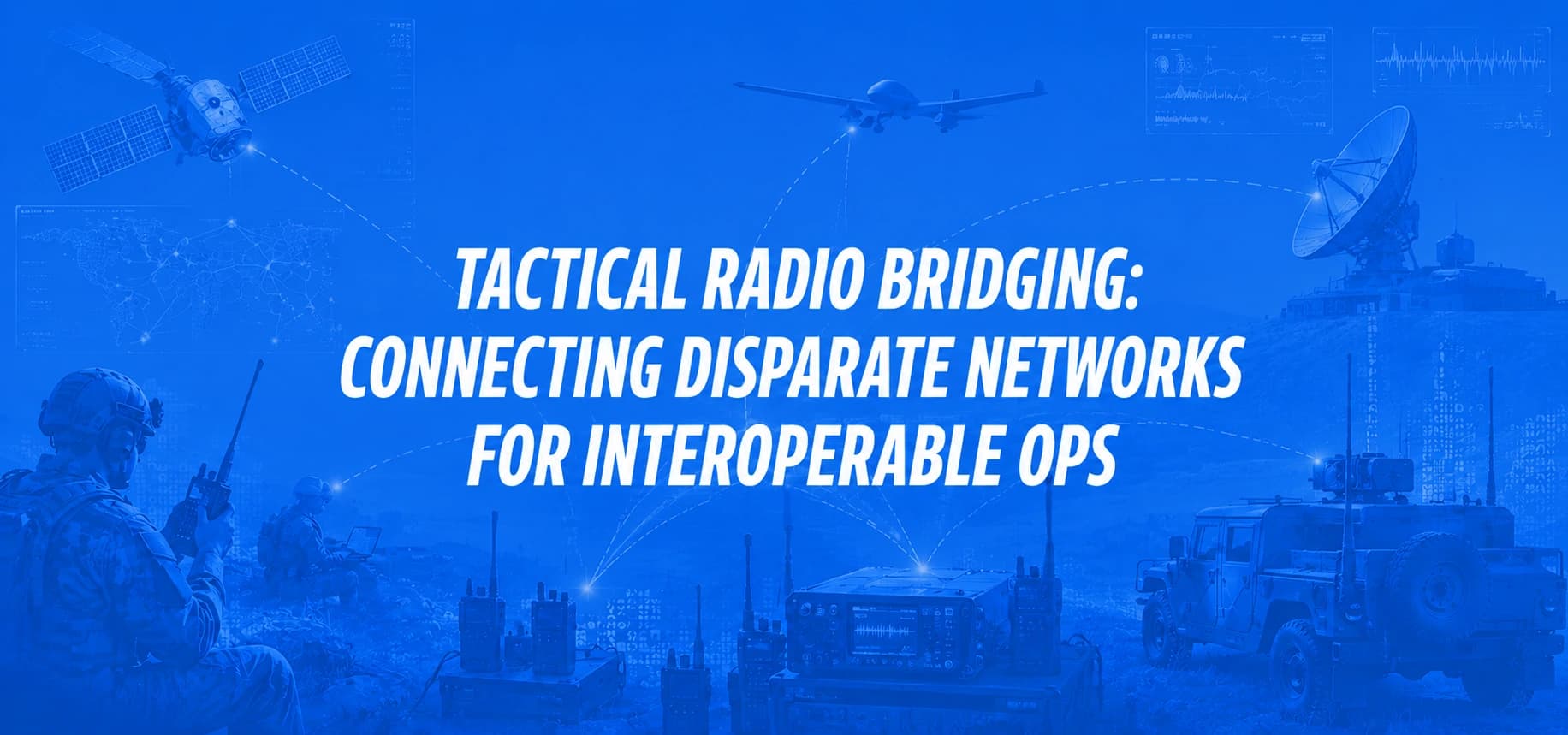
The modern joint battlespace presents a communications paradox: the forces that most need to communicate with each other are often equipped with radio systems that cannot directly communicate with each other. Army ground forces operate on different frequency bands than Air Force close air support aircraft. Coalition partners use different waveforms than U.S. forces. Special operations units carry different radio equipment than the conventional forces they are operating alongside. Tactical radio bridging is the solution to this paradox, and Parraid's NRG platform is one of the most capable radio bridging solutions available for military operations.
Tactical radio bridging connects two or more radio networks operating on different frequencies, different waveforms, or different protocols so that users on each network can communicate with users on the others. A bridge monitors multiple radio channels simultaneously, detecting transmissions on each channel and re-transmitting the audio and data content on the other connected channels. From the perspective of each radio user, the bridge is invisible and they hear the same audio and experience the same push-to-talk behavior as a direct radio connection.
Effective tactical radio bridging requires the ability to handle a diverse range of radio technologies. The Network Radio Gateway (NRG) supports multiple simultaneous radio channels across different frequency bands, enabling it to bridge HF, VHF, and UHF radio networks in a single deployment. Its software-configurable interface adapts to different waveforms and radio protocols, providing the flexibility needed to address the full diversity of radio equipment found in joint and coalition operations.
By using IP networks to carry bridged radio traffic, the NRG enables tactical radio bridging at distances that would be impractical with direct RF connections. A radio network operating in one geographic area can be bridged to another network operating hundreds of miles away, with the NRG nodes at each end of the connection communicating over a tactical WAN, satellite link, or other IP transport. This distributed bridging capability is particularly valuable for joint operations where the forces needing to communicate are separated by significant distances.
Tactical radio networks operating on classified frequencies carry sensitive information that must be protected against interception. The NRG's bridging architecture is designed to be compatible with the encryption systems used on classified tactical radio networks, ensuring that bridged communications maintain the same level of security as direct radio communications. This encryption compatibility is a critical differentiator for military applications where unencrypted bridging solutions would be unacceptable.
Parraid's NRG has been deployed in a variety of tactical radio bridging applications, demonstrating the platform's reliability and effectiveness in real operational environments. This deployment experience has informed the product's development, resulting in a system that addresses the practical challenges of tactical radio bridging rather than theoretical requirements. The NRG rack-mount deployable systems provide ruggedized packaging for field deployment. Contact Parraid to discuss your radio bridging requirements.
Powering secure, real-time data transmission across land, sea, and sky.
Dive into our blog for the latest trends, tips, and insights in the world of design and AI technology. Whether you’re looking for inspiration, tutorials, or industry news, our articles are crafted to keep you informed and inspired.
Parraid provides tactical communications solutions, telemetry data systems, and deployable communication products that support mission-critical operations around the globe. Below are some of the most common questions about our technology, services, and support.
Parraid works with aerospace, defense, government, and research organizations that depend on real-time data and secure communications. Our products are engineered to meet the unique operational needs of mission-critical and tactical environments.
Our telemetry data systems enable accurate data acquisition, recording, and playback across test ranges and aerospace applications. With IRIG-106 compliance and TMoIP support, we deliver precise insights for faster mission validation and system performance analysis.
Parraid’s tactical communications solutions are designed for interoperability and resilience. They integrate seamlessly with multi-band radios, SATCOM, and IP-based networks to maintain command, control, and situational awareness in any field condition.
Yes. Our deployable communication products are lightweight, ruggedized, and MIL-STD compliant, ideal for rapid setup and sustained connectivity in mobile or remote missions.
Absolutely. We work closely with our customers to design and configure systems tailored to their operational goals. Whether upgrading existing telemetry infrastructure or developing a fully deployable communication suite, we ensure seamless integration and lifecycle support.
All Parraid systems are designed, built, and supported in the United States. Our team of engineers and specialists provides continuous technical support to ensure mission reliability and customer success.
Connect With Our Team
All Parraid systems are designed, built, and supported in the United States. Our team of engineers and specialists provides continuous technical support to ensure mission reliability and customer success.
Powering secure, real-time data transmission across land, sea, and sky.

Parraid delivers mission-critical telemetry and tactical communications solutions designed to perform when failure is not an option.