Email : sales@parraid.com
Call Us : +1 (301) 690-0690

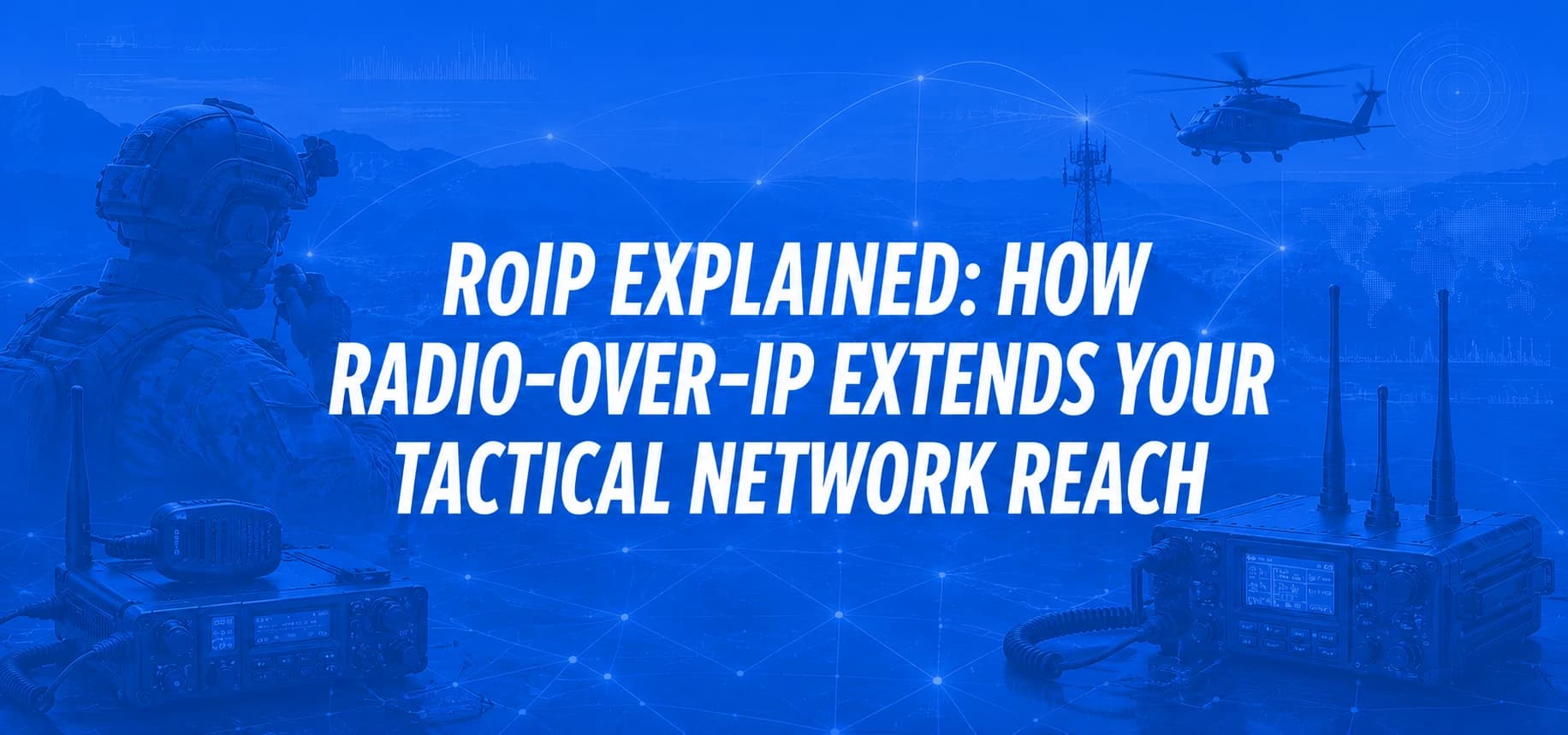
Radio has been the foundation of tactical military communications for over a century, and it remains indispensable today. No other communications technology provides the combination of portability, reliability, and immediate availability that radio delivers in the field. But radio has limitations: range, interoperability between different radio types, and the geographic constraints of RF propagation. Radio-over-IP (RoIP) addresses these limitations by marrying the radio interface that tactical users rely on with the range and flexibility of IP networks.
RoIP converts radio audio and control signals — the push-to-talk activation, the audio content of a transmission, and the squelch state that indicates receive activity — into IP data streams that can be transported over any IP network, including tactical mesh networks, satellite links, and commercial internet connections. At the destination, the IP stream is converted back to radio signals that drive conventional radio equipment or software radio clients, preserving the familiar radio operating experience for the end user.
From the perspective of a soldier or aviator using a radio connected to a RoIP gateway, the experience is identical to using the radio for direct RF communication — with the crucial difference that the actual RF transmission takes place at the location of the gateway, which may be hundreds of miles away from the user.
The most obvious application of RoIP is range extension. A tactical radio operating in mountainous terrain may have effective range of only a few kilometers. Connected through a RoIP gateway to an IP network, the same radio can communicate with any other RoIP-connected radio anywhere in the world. This range extension capability is particularly valuable for forces operating in challenging terrain, or for connecting forward deployed units with rear echelon command elements separated by long distances.
A more sophisticated application of RoIP is enabling interoperability between radio systems that are not otherwise compatible. Military forces routinely operate with a diverse mix of radio equipment, different frequency bands, different waveforms, different manufacturers that cannot directly communicate with each other. By connecting each radio type to a RoIP gateway, all of these diverse systems can be interconnected through the IP network, enabling communications across the entire force regardless of equipment incompatibilities.
Parraid's Network Radio Gateway (NRG) implements RoIP capabilities along with the management, monitoring, and security functions required for military applications. The NRG handles the conversion between radio interfaces and IP streams, manages encryption compatibility, and integrates with network management systems that provide visibility into the health of the RoIP infrastructure. The NRG rack-mount deployable systems package these capabilities in field-deployable enclosures suitable for tactical operations.
RoIP systems handling classified communications must address security requirements beyond those of commercial VoIP applications. The NRG is designed with these requirements in mind, supporting integration with approved encryption systems and complying with DoD network connection requirements for classified networks. Its security architecture ensures that RoIP connectivity does not create new vulnerabilities in the tactical communications infrastructure.
Organizations evaluating RoIP for tactical communications applications should consider their radio inventory, their network infrastructure, and the specific interoperability requirements of their missions. Parraid's experienced team can help assess these factors and recommend the right NRG configuration for your situation. Explore Parraid's deployable communications solutions to learn more.
Powering secure, real-time data transmission across land, sea, and sky.
Dive into our blog for the latest trends, tips, and insights in the world of design and AI technology. Whether you’re looking for inspiration, tutorials, or industry news, our articles are crafted to keep you informed and inspired.

Parraid provides tactical communications solutions, telemetry data systems, and deployable communication products that support mission-critical operations around the globe. Below are some of the most common questions about our technology, services, and support.
Parraid works with aerospace, defense, government, and research organizations that depend on real-time data and secure communications. Our products are engineered to meet the unique operational needs of mission-critical and tactical environments.
Our telemetry data systems enable accurate data acquisition, recording, and playback across test ranges and aerospace applications. With IRIG-106 compliance and TMoIP support, we deliver precise insights for faster mission validation and system performance analysis.
Parraid’s tactical communications solutions are designed for interoperability and resilience. They integrate seamlessly with multi-band radios, SATCOM, and IP-based networks to maintain command, control, and situational awareness in any field condition.
Yes. Our deployable communication products are lightweight, ruggedized, and MIL-STD compliant, ideal for rapid setup and sustained connectivity in mobile or remote missions.
Absolutely. We work closely with our customers to design and configure systems tailored to their operational goals. Whether upgrading existing telemetry infrastructure or developing a fully deployable communication suite, we ensure seamless integration and lifecycle support.
All Parraid systems are designed, built, and supported in the United States. Our team of engineers and specialists provides continuous technical support to ensure mission reliability and customer success.
Connect With Our Team
All Parraid systems are designed, built, and supported in the United States. Our team of engineers and specialists provides continuous technical support to ensure mission reliability and customer success.
Powering secure, real-time data transmission across land, sea, and sky.

Parraid delivers mission-critical telemetry and tactical communications solutions designed to perform when failure is not an option.