Email : sales@parraid.com
Call Us : +1 (301) 690-0690

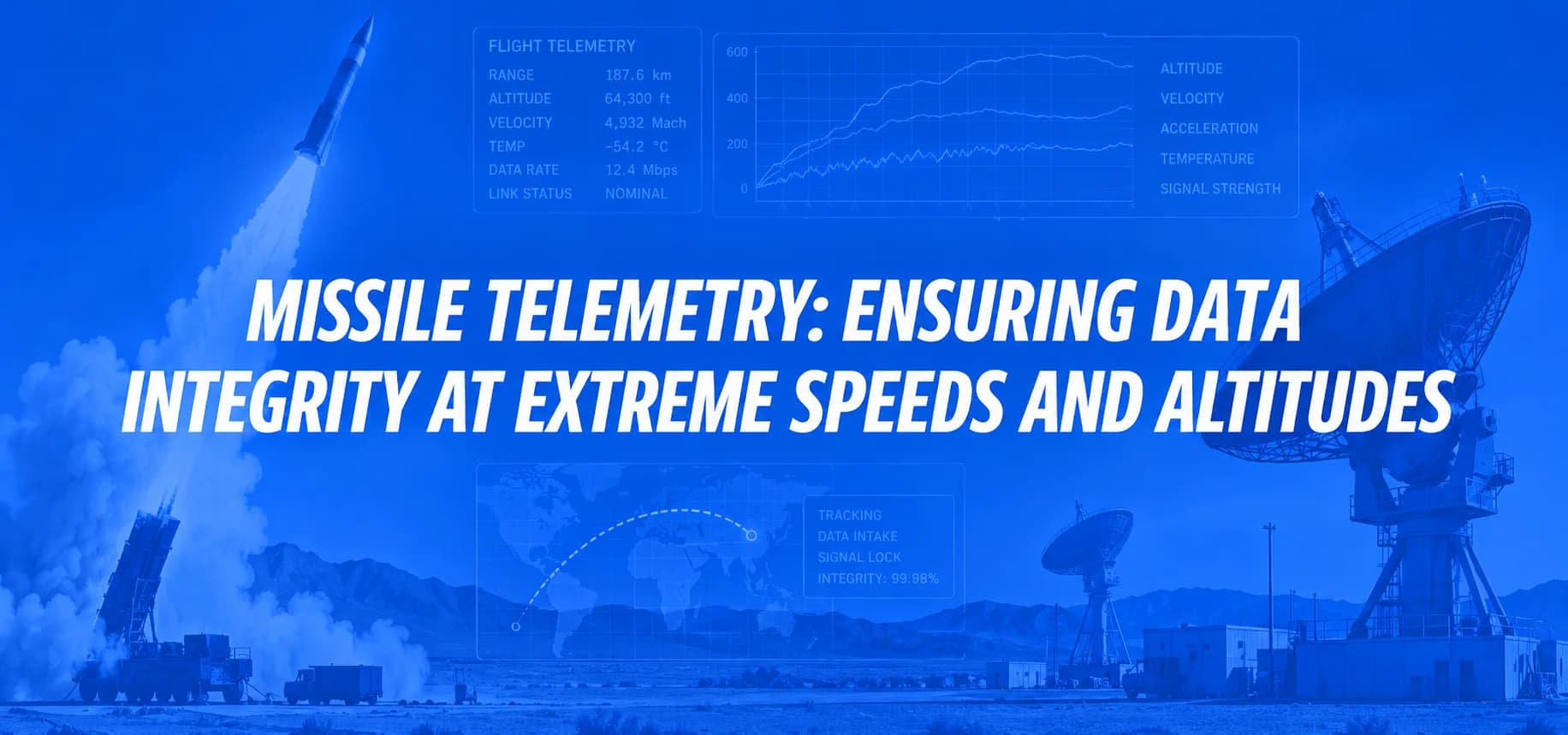
Missile testing is among the most challenging environments for telemetry systems. The test article may be traveling at several times the speed of sound, experiencing vibration levels that would destroy conventional electronics, at altitudes where atmospheric pressure is a tiny fraction of sea level, and for a duration measured in seconds to minutes that allows no opportunity to troubleshoot or recover from equipment failures. Despite these challenges, the telemetry system must capture every critical parameter with complete reliability, because there is typically no second-chance to repeat the very expensive test.
Missiles and high-performance munitions generate some of the most extreme environments encountered in flight tests. Setback acceleration during launch can exceed hundreds of g's. Aerodynamic heating at high Mach numbers reaches temperatures that challenge even specialized high-temperature sensors. Vibration environments during boost phase can cause sensor failures and connector issues that ground-based qualification testing may not fully replicate. Every component of the telemetry system from the onboard transmitter to the ground receiver system, all must be designed for this environment.
For hypersonic flight testing, missile telemetry, and advanced aerospace development programs, maintaining access to high-quality telemetry data is essential for mission success. Parraid's IMUX G2e™ and G2eH™ Recorders provide advanced ground-based telemetry recording capabilities that capture, archive, and replay critical flight test data for detailed post-mission analysis. To further improve data reliability, Parraid's Best Data Engine (BDE™) continuously evaluates multiple incoming telemetry streams and automatically selects the highest-quality data source, helping minimize data gaps caused by signal degradation, range transitions, or changing test conditions. By combining robust telemetry recording with intelligent Best Source Selection technology, Parraid enables aerospace and defense organizations to maximize telemetry data recovery, improve data integrity, and ensure comprehensive mission analysis for hypersonic vehicle testing, missile development programs, and other demanding flight test operations.
Long-range missile tests often require multiple receive stations positioned along the planned flight path to maintain continuous telemetry coverage. As the missile moves through the range, signal quality can vary between stations due to distance, geometry, and environmental conditions. Parraid's Best Data Engine (BDE™) continuously evaluates telemetry data from multiple receive sources and generates a single, high-quality composite data stream for recording and real-time monitoring. By combining the best available data from all participating stations, BDE helps eliminate data loss, reduce errors, and maintain reliable telemetry visibility throughout the mission.
Modern missiles carry sophisticated sensor suites that generate high data rates, structural health monitoring, aerodynamic measurements, propulsion system telemetry, guidance and navigation data, all simultaneously. Processing this data in real-time requires high-throughput decommutation capability. The S-5000e data processor handles these high data rates, and OMEGA NExT provides the real-time display capability that allows range engineers to monitor critical parameters during the brief flight window.
After the flight, the engineering team must extract maximum insight from the recorded telemetry data to support design improvements, validate performance models, and document compliance with test objectives. The Omega Data Environment (ODE) provides a comprehensive post-processing environment for missile telemetry data, supporting parameter extraction, time-history plots, and statistical analysis across multiple test events. To discuss missile telemetry system requirements, contact Parraid.
Powering secure, real-time data transmission across land, sea, and sky.
Dive into our blog for the latest trends, tips, and insights in the world of design and AI technology. Whether you’re looking for inspiration, tutorials, or industry news, our articles are crafted to keep you informed and inspired.
Parraid provides tactical communications solutions, telemetry data systems, and deployable communication products that support mission-critical operations around the globe. Below are some of the most common questions about our technology, services, and support.
Parraid works with aerospace, defense, government, and research organizations that depend on real-time data and secure communications. Our products are engineered to meet the unique operational needs of mission-critical and tactical environments.
Our telemetry data systems enable accurate data acquisition, recording, and playback across test ranges and aerospace applications. With IRIG-106 compliance and TMoIP support, we deliver precise insights for faster mission validation and system performance analysis.
Parraid’s tactical communications solutions are designed for interoperability and resilience. They integrate seamlessly with multi-band radios, SATCOM, and IP-based networks to maintain command, control, and situational awareness in any field condition.
Yes. Our deployable communication products are lightweight, ruggedized, and MIL-STD compliant, ideal for rapid setup and sustained connectivity in mobile or remote missions.
Absolutely. We work closely with our customers to design and configure systems tailored to their operational goals. Whether upgrading existing telemetry infrastructure or developing a fully deployable communication suite, we ensure seamless integration and lifecycle support.
All Parraid systems are designed, built, and supported in the United States. Our team of engineers and specialists provides continuous technical support to ensure mission reliability and customer success.
Connect With Our Team
All Parraid systems are designed, built, and supported in the United States. Our team of engineers and specialists provides continuous technical support to ensure mission reliability and customer success.
Powering secure, real-time data transmission across land, sea, and sky.

Parraid delivers mission-critical telemetry and tactical communications solutions designed to perform when failure is not an option.