Email : sales@parraid.com
Call Us : +1 (301) 690-0690

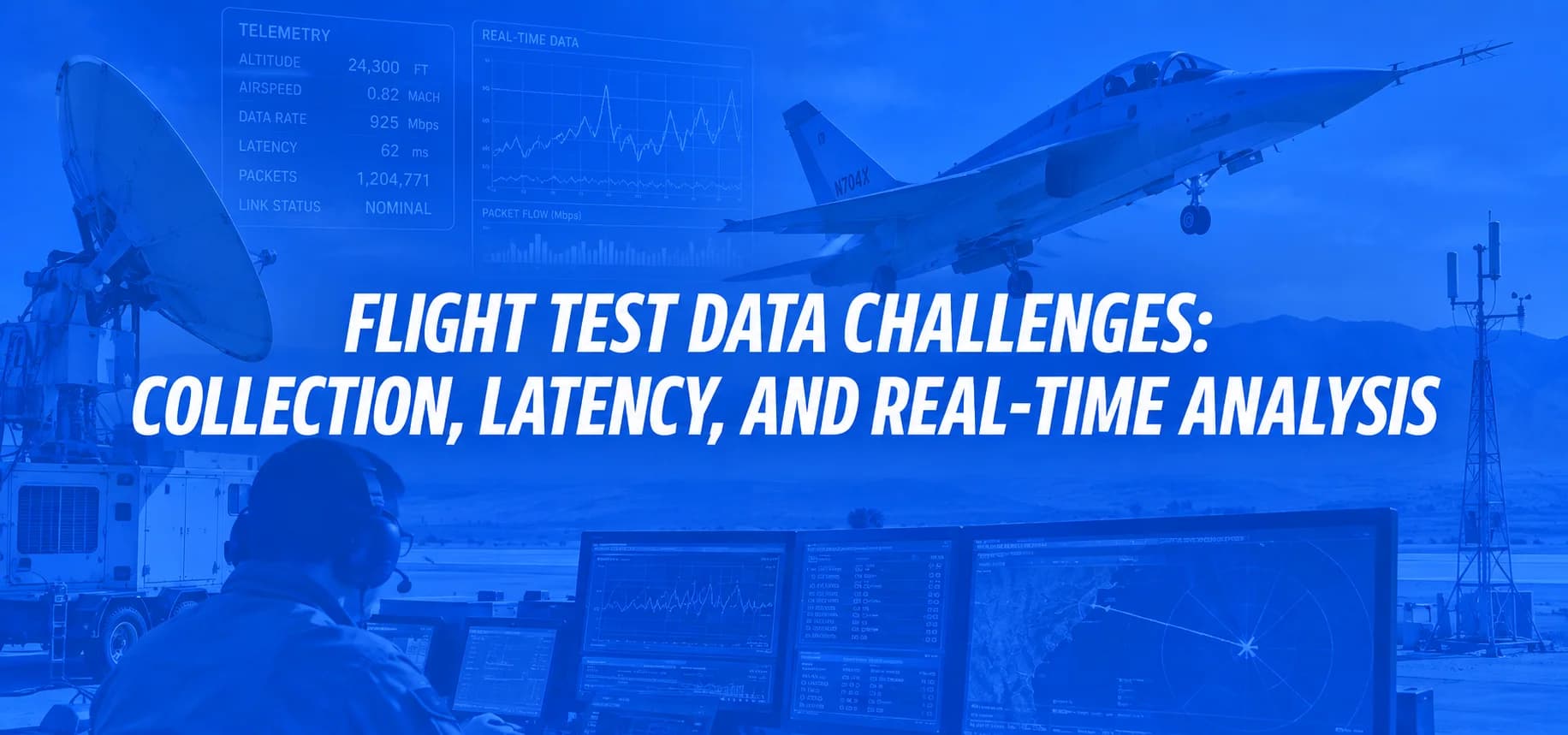
Flight test is among the most data-intensive activities in the aerospace industry. A modern developmental aircraft may carry hundreds of sensors measuring thousands of parameters, generating data at rates that would have been unimaginable on test programs of a generation ago. This data richness is a genuine engineering asset and it enables more thorough characterization of aircraft performance and more rapid identification of anomalies. But it also creates a set of operational challenges that test programs must address: how to collect all of this data reliably, how to minimize the latency between data generation and availability for real-time monitoring, and how to analyze it rapidly enough to support compressed test timelines.
Collecting telemetry data from a modern test article requires an end-to-end chain of systems, onboard sensors, data acquisition units, onboard recorders or transmitters, RF links, receive antennas, demodulators, ground recorders, and processing systems. Each of which must perform reliably throughout the flight. A failure anywhere in this chain can result in data loss that invalidates test points or even the entire flight. The IMUX G2e and G2eH recorders address the collection challenge with dual-path recording that eliminates single points of failure in the ground recording infrastructure.
Real-time telemetry monitoring is only valuable if the data being displayed accurately and reflects the current state of the test article. Latency, the delay between a sensor reading on the aircraft and its appearance on the ground station display. Latency must be minimized to ensure that test conductors and range safety officers are responding to current conditions, not conditions that existed seconds or minutes ago. Modern TMoIP architectures like those supported by the G3 TMoIP platform minimize latency by eliminating analog intermediate processing stages and delivering data directly to processing workstations over low-latency network connections.
The purpose of real-time telemetry monitoring is to support decisions made during the flight: decisions about whether to continue to the next test point, whether to abort the mission due to an anomaly, or whether safety limits are being approached. The OMEGA NExT processing software provides the real-time decommutation and display capabilities that enable these decisions, converting raw telemetry data into engineering unit displays that test conductors can interpret immediately without specialized signal processing knowledge.
In a compressed test schedule, the time available between flights for post-flight data analysis may be measured in hours rather than days. Engineers need to extract key parameters, generate plots, identify anomalies, and brief preliminary results to program managers before the next planned flight. The Omega Data Environment (ODE) supports this rapid turnaround requirement with automated processing pipelines that begin working on recorded data immediately after landing, producing preliminary engineering unit files before the aircraft has even taxied back to the hangar.
Data volumes in flight test are growing faster than storage costs are falling, driven by the adoption of high-speed data buses, higher-resolution sensors, and increased sensor counts. Telemetry systems must scale to handle this growth without requiring complete infrastructure replacement on each new program. Parraid's portfolio — including the S-5000e data processor and the IMUX RE-CON are designed with scalability in mind. To discuss your flight test data infrastructure, contact Parraid.
Powering secure, real-time data transmission across land, sea, and sky.
Dive into our blog for the latest trends, tips, and insights in the world of design and AI technology. Whether you’re looking for inspiration, tutorials, or industry news, our articles are crafted to keep you informed and inspired.
Parraid provides tactical communications solutions, telemetry data systems, and deployable communication products that support mission-critical operations around the globe. Below are some of the most common questions about our technology, services, and support.
Parraid works with aerospace, defense, government, and research organizations that depend on real-time data and secure communications. Our products are engineered to meet the unique operational needs of mission-critical and tactical environments.
Our telemetry data systems enable accurate data acquisition, recording, and playback across test ranges and aerospace applications. With IRIG-106 compliance and TMoIP support, we deliver precise insights for faster mission validation and system performance analysis.
Parraid’s tactical communications solutions are designed for interoperability and resilience. They integrate seamlessly with multi-band radios, SATCOM, and IP-based networks to maintain command, control, and situational awareness in any field condition.
Yes. Our deployable communication products are lightweight, ruggedized, and MIL-STD compliant, ideal for rapid setup and sustained connectivity in mobile or remote missions.
Absolutely. We work closely with our customers to design and configure systems tailored to their operational goals. Whether upgrading existing telemetry infrastructure or developing a fully deployable communication suite, we ensure seamless integration and lifecycle support.
All Parraid systems are designed, built, and supported in the United States. Our team of engineers and specialists provides continuous technical support to ensure mission reliability and customer success.
Connect With Our Team
All Parraid systems are designed, built, and supported in the United States. Our team of engineers and specialists provides continuous technical support to ensure mission reliability and customer success.
Powering secure, real-time data transmission across land, sea, and sky.

Parraid delivers mission-critical telemetry and tactical communications solutions designed to perform when failure is not an option.