Email : sales@parraid.com
Call Us : +1 (301) 690-0690

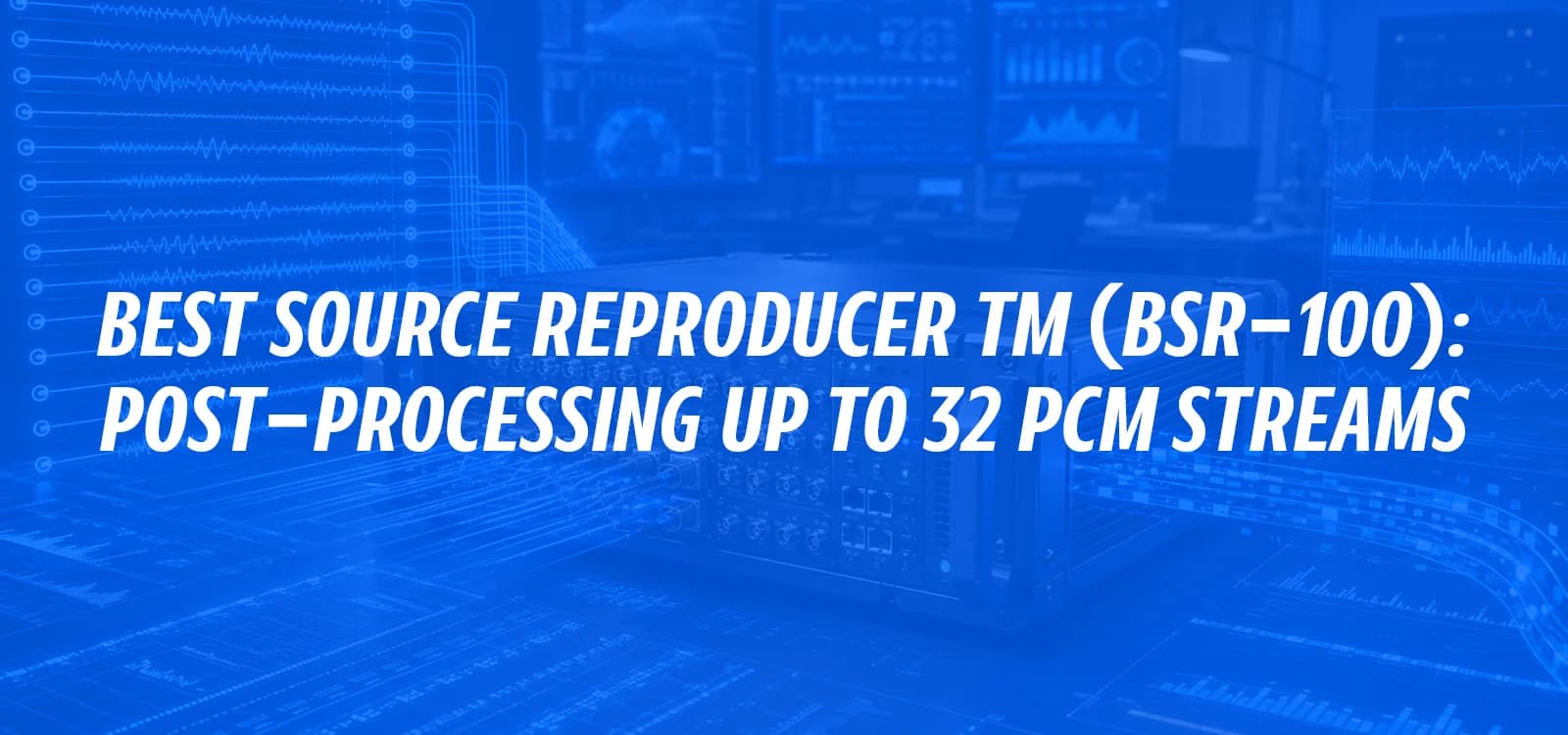
Not every flight test program has the luxury of implementing real-time best source selection in the field. Budget constraints, timeline pressures, or the complexity of managing a live best source selection system during a demanding test event sometimes lead programs to record all available receive paths independently and defer the source selection to post-flight processing. For these programs, the BSR-100 Best Source Reproducer from Parraid provides a powerful and flexible solution: capable of combining up to 32 independent PCM streams into a single high-quality composite recording.
Post-processing best source selection has several advantages over real-time selection in certain scenarios. The selection algorithm has access to the complete recorded data from all sources, rather than making decisions based solely on real-time signal quality metrics. This means the algorithm can look ahead in the data stream to confirm that a candidate source is truly clean before committing to a selection. Additionally, post-processing allows the selection parameters to be tuned after the fact, if the initial selection produces artifacts, the operator can adjust thresholds and re-run the algorithm until the composite output meets quality requirements.
The BSR-100 accepts up to 32 input PCM streams simultaneously, reading recorded data from Chapter 10 files or direct PCM interfaces. Its source selection algorithms evaluate each input stream frame by frame, selecting the source with the lowest estimated bit error rate for each output frame. The resulting composite stream is written to a new Chapter 10 file that can be processed by any standard Chapter 10-compliant analysis tool. The selection algorithm is configurable, allowing operators to weight different quality metrics according to their specific program requirements.
For programs processing large volumes of recorded data from multiple test missions, the BSR-100 integrates with the Omega Data Environment (ODE) to provide a scalable post-processing pipeline. ODE manages the data workflow, ingesting raw recordings, dispatching processing jobs to the BSR-100, and organizing resulting composite files — while the BSR-100 handles the computationally intensive source selection work. This integration enables large programs to process multiple missions simultaneously, dramatically reducing the time from flight to analyzed results.
The BSR-100 generates comprehensive selection logs documenting which source was selected at every point in the output stream, along with the quality metrics that drove the selection decision. These logs enable engineers to verify that the composite output meets quality requirements and provide a permanent record for program archives documenting the provenance of every parameter in the processed data stream.
The choice between the Best Data Engine (BDE) for real-time selection and the BSR-100 for post-processing depends on program requirements. Programs where real-time monitoring is flight safety critical should use the BDE. Programs that can tolerate a post-processing cycle may prefer the BSR-100's iterative flexibility. Many programs use both: the BDE during flight for real-time safety monitoring, and the BSR-100 after flight for the highest quality composite recording. Contact Parraid's team to discuss which approach best fits your requirements.
Powering secure, real-time data transmission across land, sea, and sky.
Dive into our blog for the latest trends, tips, and insights in the world of design and AI technology. Whether you’re looking for inspiration, tutorials, or industry news, our articles are crafted to keep you informed and inspired.

Parraid provides tactical communications solutions, telemetry data systems, and deployable communication products that support mission-critical operations around the globe. Below are some of the most common questions about our technology, services, and support.
Parraid works with aerospace, defense, government, and research organizations that depend on real-time data and secure communications. Our products are engineered to meet the unique operational needs of mission-critical and tactical environments.
Our telemetry data systems enable accurate data acquisition, recording, and playback across test ranges and aerospace applications. With IRIG-106 compliance and TMoIP support, we deliver precise insights for faster mission validation and system performance analysis.
Parraid’s tactical communications solutions are designed for interoperability and resilience. They integrate seamlessly with multi-band radios, SATCOM, and IP-based networks to maintain command, control, and situational awareness in any field condition.
Yes. Our deployable communication products are lightweight, ruggedized, and MIL-STD compliant, ideal for rapid setup and sustained connectivity in mobile or remote missions.
Absolutely. We work closely with our customers to design and configure systems tailored to their operational goals. Whether upgrading existing telemetry infrastructure or developing a fully deployable communication suite, we ensure seamless integration and lifecycle support.
All Parraid systems are designed, built, and supported in the United States. Our team of engineers and specialists provides continuous technical support to ensure mission reliability and customer success.
Connect With Our Team
All Parraid systems are designed, built, and supported in the United States. Our team of engineers and specialists provides continuous technical support to ensure mission reliability and customer success.
Powering secure, real-time data transmission across land, sea, and sky.

Parraid delivers mission-critical telemetry and tactical communications solutions designed to perform when failure is not an option.